High-Quality Decisions, Costs: Why We’re Pro-Capped Fee Adjudication
High-Quality Decisions, Costs: Why We’re Pro-Capped Fee Adjudication
For years, the construction industry has viewed adjudication as the "rough and ready" mechanism for resolving disputes. It was designed to be fast, effective, and, crucially, less expensive than traditional litigation. However, as the complexity of construction projects has evolved, so too has the complexity of the disputes arising from them. We have seen a shift where adjudication has frequently morphed into "litigation-lite," complete with escalating legal fees and adjudicator costs that can sometimes rival the value of the claim itself.
At Veritas Surveying Limited, we have closely monitored the emergence and development of capped-fee adjudication schemes. Our position is clear: when managed correctly, capped fee schemes provide the commercial certainty and forensic rigour that modern construction parties demand. Far from being a "budget" version of justice, these schemes are increasingly proving to be the most efficient route to high-quality, enforceable decisions.
The Rise of Financial Predictability: Understanding the Schemes
In our view, the primary barrier to pursuing a legitimate claim is often the fear of the unknown, specifically, the unknown cost of the process. Capped-fee adjudication removes this obstacle by setting a predetermined ceiling on the adjudicator’s fees. Several key frameworks have paved the way for this shift.
1. The CIC Low Value Dispute (LVD) Model Adjudication Procedure (MAP)
The Construction Industry Council (CIC) launched the LVD MAP to address disproportionate costs in lower-value claims (typically those up to £100,000). The procedure operates on a sliding scale of capped fees based on the value of the dispute. For a party seeking a decision of an adjudicator the LVD MAP offers a transparent roadmap of exactly what the adjudicator will charge.
2. The UK Adjudicators’ Capped Fee Scheme
Complementing the CIC’s efforts, the UK Adjudicators’ scheme provides another robust alternative. It is designed to ensure that the costs of the adjudicator do not consume the potential "win" for the referring party. This scheme is particularly useful for all manner of disputes and, as standard, will accept claims up to £250,000.00 plus VAT on the fee cap. This scheme is highly regarded for its administrative efficiency and the quality of the adjudicators on its panel.
3. The TeSCA Capped Fee Scheme
The Technology and Construction Solicitors Association (TeSCA) also provides a fixed-fee adjudication service for claims up to a certain threshold (often £50,000).
Quality is Not Negotiable: The Myth of the "Cheap" Decision
A common concern among legal representatives and commercial directors is that a "capped fee" might lead to a "capped effort." There is a lingering fear that if an adjudicator’s fee is limited, they may not dedicate the necessary time to pore over complex forensic evidence or nuanced legal arguments. In our experience at Veritas Surveying, this fear is largely unfounded especially when using the UKA Capped Fee Scheme. We have been involved in numerous adjudication cases in which we have seen counsel from top-tier sets, such as 39 Essex and Keating Chambers, deliver exceptionally high-quality decisions within a capped-fee framework.
The reason is simple: the best adjudicators are professionals who value their reputation and the integrity of the process. They are also highly efficient. A capped fee does not signal a reduction in quality; rather, it incentivises a more focused, streamlined approach to the core issues of the dispute. When you engage a party representative to prepare a robust submission, a high-calibre adjudicator can identify the "wheat from the chaff" far more quickly than other counterparts, regardless of the fee structure.
Should Capped Fee Schemes be the "Standard Go-To"?
In our view, yes: provided the complexity of the dispute aligns with the chosen scheme. While extremely large, multi-issue professional negligence or massive infrastructure claims may still require the flexibility of uncapped proceedings, the vast majority of "standard" construction disputes would benefit from this approach.
Why it should be your first choice:
- Commercial Certainty: Boards and Business Owners hate financial ambiguity. Knowing the maximum exposure for adjudicator fees allows for accurate risk assessment and budgeting.
- Proportionality: It forces both parties to consider whether their legal spend is proportional to the amount in dispute.
- Speed: Capped fee procedures often come with tighter timelines and limited submissions, preventing the "paper warfare" that often bogs down standard adjudications.
- Focus: It encourages parties to distill their arguments to the most critical points of entitlement and quantum.
The Veritas Perspective: Strategic Advantage through Certainty
We advocate for the use of these schemes because they align with our own philosophy of forensic precision and commercial pragmatism. When we act as a quantity surveyor in Manchester or provide expert witness construction services, our goal is always to provide the client with a clear path to resolution.
Using capped fee schemes allows us to tell our clients with confidence: "This is what the process will cost, and this is the quality of the decision-maker you will get." By utilising adjudicators from esteemed sets like 39 Essex, Keating Chambers or even independents under these schemes, we ensure that our clients receive the highest level of legal and technical scrutiny without the risk of an uncapped fee note at the end of the 28-day period.
Practical Tips for Parties and Representatives
If you are considering a capped fee adjudication, keep these strategic points in mind:
- Check Your Contract: Many standard forms (like JCT or NEC) allow parties to agree on the adjudication procedure. If you want a capped fee scheme, ensure your notice of adjudication explicitly names the scheme or that you seek the other party’s agreement early on.
- Select the Right Scheme: If your dispute is under £100k, the CIC LVD MAP may be appropriate. For disputes that are slightly larger but still require cost control, explore the UK Adjudicators or TeSCA options.
- Front-Load Your Evidence: In a capped fee environment, the adjudicator’s time is precious. Ensure your Referral Notice is as clear, concise, and well-evidenced as possible. This is where a quantity surveyor or a quantum specialist can make the difference between success and failure.
- Agree on the Adjudicator Early: If you can agree on a high-quality adjudicator from a top chambers who is willing to work within a capped fee, you have already won half the battle in ensuring a fair and robust outcome.
Conclusion: A Protective Shield for Your Interests
The evolution of capped-fee adjudication represents the maturation of the construction industry’s approach to dispute resolution. It acknowledges that justice shouldn't be a luxury accessible only to those with bottomless legal budgets.
At Veritas Surveying Limited, our positive experience with these schemes has reinforced our belief that they provide a protective shield for our clients' interests. By combining the forensic expertise of a quantum expert with the cost-certainty of the CIC, UK Adjudicators, or TeSCA schemes, we can resolve disputes in a way that is both intellectually rigorous and commercially sensible.
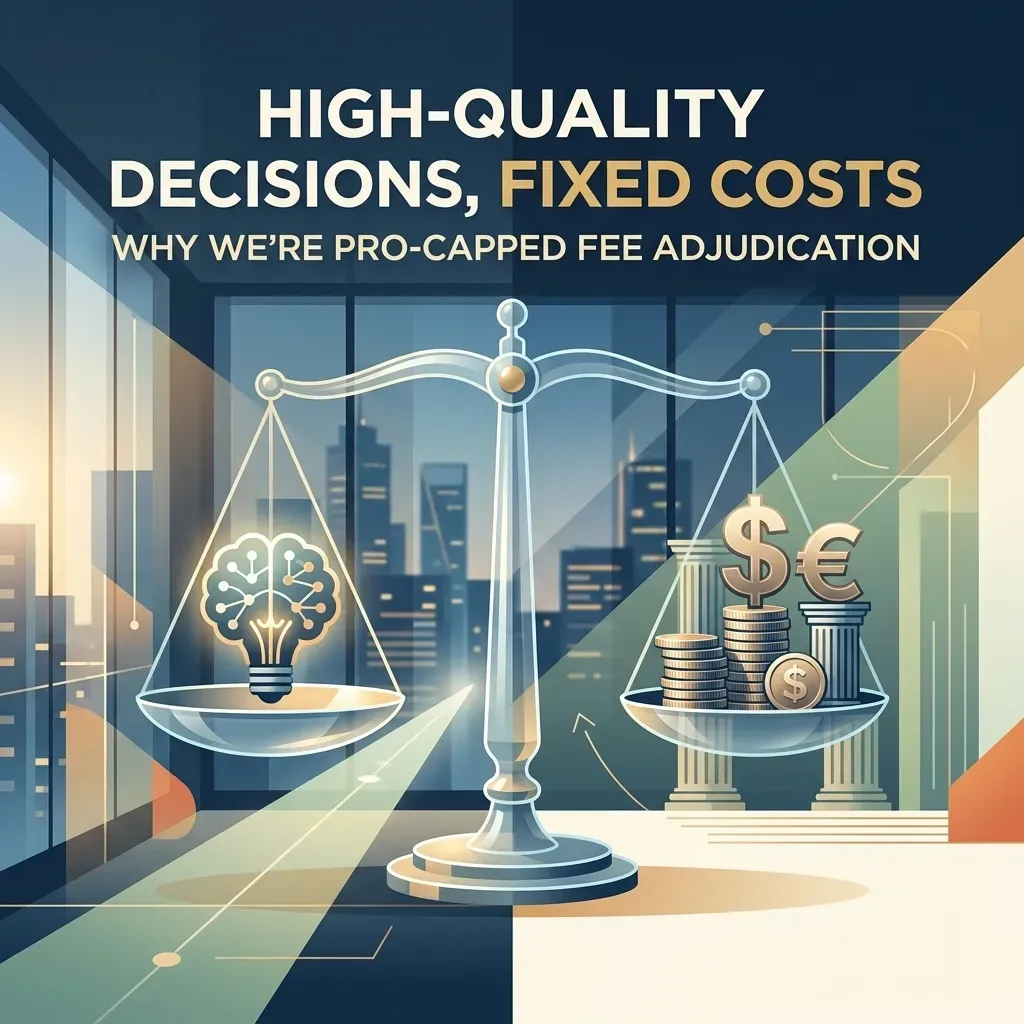
High-quality decisions and fixed costs are no longer mutually exclusive. In the modern construction landscape, they are hallmarks of a sophisticated, strategic approach to dispute management.
Need expert guidance on your next adjudication?
Whether you require a
quantity surveyor in Manchester or specialised
expert witness support, Veritas Surveying Limited is here to help you navigate the complexities of capped fee schemes and beyond.
Contact us today to discuss how we can bring certainty to your construction disputes.